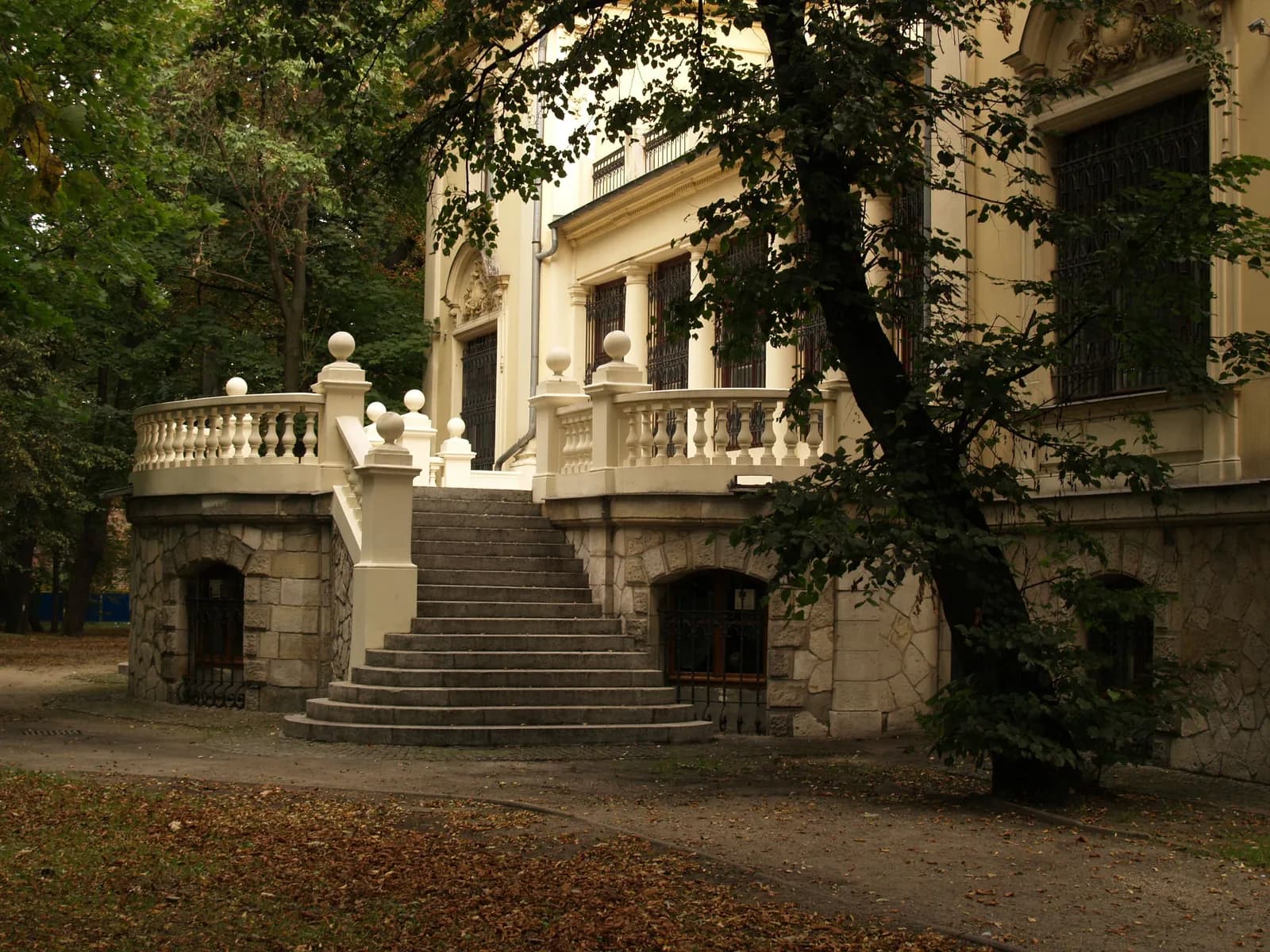
A family built its fortune here through industry; generations later, their former residence tells a much wider story about Sosnowiec and its people.
Sosnowiec grew rapidly during the industrial expansion of the late 19th century, when factories, railways and new communities transformed what had previously been a much smaller settlement. Among the families who became part of this transformation were Ernst and Franz Schoen, brothers who arrived from Werdau in Saxony in 1875.
Their industrial enterprise would become one of the most significant in the area. Their factories produced wool and textiles, while a later factory in Sielec expanded their interests into knitwear and stockings. The business operated through the CG Schön Trading House and developed extensive markets across the Kingdom of Poland and Russia.
The family's prosperity was reflected in the landscape they created around their factories. Workers' and officials' housing was built nearby, while the Schoens established their own residences.
Among them was the impressive palace built for Ernst Schoen.
A residence shaped by the industrial age
Designed by Wrocław architect Karl Grosser, Ernst Schoen's residence stood beside the Warsaw-Vienna railway line, placing the family home directly within the rapidly changing industrial landscape.
The palace was built in the Neo-Baroque style and surrounded by a large park designed in the Neo-Romantic fashion popular among wealthy industrial families of the period.
Its architecture reflected the status of its owner. The characteristic corner towers gave the building a distinctive silhouette, while the interiors were designed for both formal entertaining and private family life.
An oval entrance hall led towards the principal rooms, including a dining room, ballroom, billiards room and orangery. Different spaces were decorated in contrasting styles, including Neo-Rococo, English and Moorish influences.
The surrounding park was equally ambitious.
Its landscape included a large pond, bridges, gazebos, stone benches, fountains and a rosarium. Artificial ruins and grottos added the picturesque quality associated with the Neo-Romantic garden tradition. A marina and bowling pavilion also formed part of the estate.
Much of that original landscape has disappeared. The pond was removed after the Second World War, while the park's walls and three entrance gates were demolished in the late 1950s.
Yet the park has retained something of its original character.
Today, the 5.6-hectare green space contains mature trees, surviving fragments of the former landscape and eleven trees designated as natural monuments. An American tulip tree is among its best-known features, particularly when it flowers in May.
When a private palace became a public institution
The palace's history changed considerably after the Second World War.
Its elegant interiors were altered during a period when the building served practical purposes, including a kindergarten and private apartments. Much of the original internal layout was lost as the building adapted to its new uses.
The palace itself, however, remained an important part of Sosnowiec's heritage.
In 1980, the palace and park complex was entered into the Katowice Voivodeship Register of Historic Monuments. Around the same time, work began on its conversion into a museum.
The transformation was completed in 1985, when the Museum at Schoen Palace opened as a branch of the Upper Silesian Museum in Bytom.
A decade later, the institution became independent under the local government of Sosnowiec.
That change gave the former industrial residence a new role. It was no longer a private home reflecting the fortunes of one family. Instead, it became a place dedicated to preserving and interpreting the history and culture of the wider region.
A palace with a wider story to tell
Today, the Museum at Schoen Palace combines historical and artistic collections with exhibitions, education, research and cultural events.
Its exhibitions explore the history of Sosnowiec and the Dąbrowa Basin, while art exhibitions have brought works by artists ranging from Jacek Malczewski and Zdzisław Beksiński to Salvador Dalí and Andy Warhol to local audiences.
The museum also looks beyond exhibition galleries. Workshops, lectures, meetings, concerts and conferences make the palace part of contemporary cultural life, while the Dąbrowa Basin Institute, established in 2018, supports research and documentation relating to the region.
This broader role is important because the story of Schoen Palace is ultimately not only about architecture.
The building emerged from a period when industrialists were reshaping Sosnowiec through factories, housing and ambitious estates. The Schoens were part of that transformation, participating in the city's social life and supporting various public and charitable initiatives.
More than a century later, their former residence has acquired a very different relationship with the city around it.
The palace and its surviving park still provide a physical reminder of Sosnowiec's industrial past, but the museum gives that heritage a public dimension. What was once a private estate has become a place where the history of an entire region can be explored, questioned and shared.
In that sense, the most significant transformation at Schoen Palace may not be architectural at all. It is the change from a residence built for one family into a cultural institution with a story belonging to many.
Visitor Information
Museum at Schoen Palace
ul. Chemiczna 12, Sosnowiec
Opening hours
Monday: Closed
Tuesday–Saturday: 10:00–19:00
Sunday: 10:00–18:00